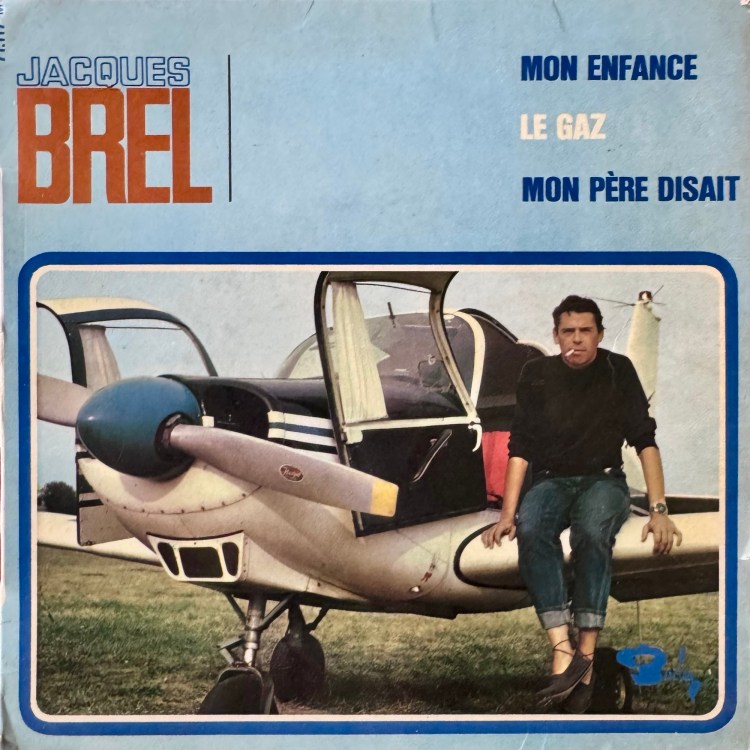
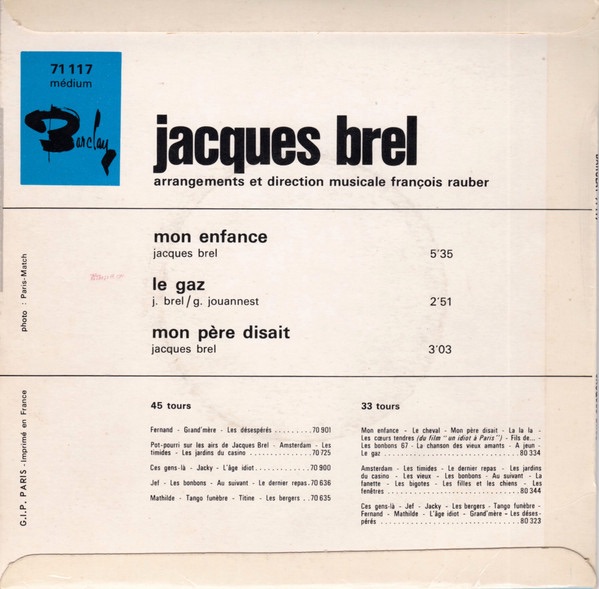
Overview
This EP showcases Jacques Brel’s exceptional range as a songwriter, blending poignant reflection with sharp wit and social critique. Opening with Mon Enfance, Brel explores the powerful influence of his Belgian homeland through the metaphor of the north wind, evoking the landscapes and traditions that shaped his identity. This introspective tribute sets a contemplative tone, rich in imagery and familial wisdom.
Transitioning to Le gaz, Brel shifts gears with a playful, humorous narrative that unveils the hidden realities of a brothel visit. Through clever lyricism and a lively musical arrangement, he critiques societal hypocrisy while maintaining an entertaining facade. Closing with Les Désespérés, the EP dives back into deep emotional territory, capturing the despair and disillusionment of lost souls. Together, these songs create a compelling tapestry that highlights Brel’s mastery in merging personal experience with universal themes, all while showcasing his unique ability to oscillate between humor and heartache.
Analysis
Opening with Mon Enfance, Brel revisits his Flemish childhood with a sense of both nostalgia and disillusionment. The song’s somber tone reflects his feelings of entrapment and isolation, building toward the emotional upheaval of adolescence and the disruptive force of war. Musically, Gérard Jouannest’s piano work complements the emotional arc of Brel’s lyrics, moving from melancholic quietude to a powerful crescendo before the abrupt arrival of World War II.
The EP balances personal memory with universal themes of love, loss, and war. The orchestration throughout, particularly in Mon Enfance, mirrors the emotional depth of Brel’s reflections, moving fluidly between restraint and intensity. The blend of lyrical introspection and rich musicality gives the EP a haunting, poignant quality that resonates with listeners long after the final note fades.
Le Gaz is a prime example of Jacques Brel’s unique ability to mix humour with biting social commentary. On the surface, it tells the comical story of a man visiting a woman’s home under the pretext of checking her gas, only for the listener to realise the house is a brothel. Brel’s sharp wit gradually reveals the risqué undertones, turning what starts as an elegant setting into a bawdy, satirical narrative. Through clever wordplay and increasingly exaggerated imagery, the song humorously critiques the hypocrisy of society, highlighting the secret lives of seemingly respectable figures like doctors, police officers, and poets who frequent the establishment.
Musically, the song evolves from a quiet, charming melody into a lively and frenetic composition that mirrors the growing absurdity of the story. François Rauber’s arrangement complements Brel’s playful vocal delivery, which begins calmly but becomes more animated as the narrative unfolds. The energy builds to a comical crescendo, creating an unforgettable live performance moment where Brel would often point to audience members, amplifying the satire. Despite its lighthearted tone, Le Gaz offers a subtle critique of societal norms, making it a clever, engaging addition to Brel’s repertoire.
Mon père disait is a nostalgic and poetic reflection on Jacques Brel’s deep connection to Belgium, evoking the influence of his father and the northern landscapes. Through vivid imagery, Brel recalls his father’s words about the north wind, which shapes the dykes of Scheveningen, the towers of Bruges, and the lives of the people in the region. The wind serves as both a literal and metaphorical force, symbolising resilience, tradition, and the enduring relationship between the land and its inhabitants. The song is a tribute to the cultural and natural heritage of Belgium, similar in spirit to Le Plat Pays, yet with a more intimate, paternal focus.
Musically, Mon père disait is a sweeping composition arranged by François Rauber, capturing the relentlessness of the north wind with its steady, atmospheric orchestration. Though some find the music repetitive, this mirrors the constant force of nature that Brel describes. The song’s thematic connections to Le Plat Pays and Jean de Bruges highlight Brel’s ongoing exploration of his homeland’s geography and culture, making it a poignant addition to his autobiographical works. Its lyrical depth compensates for any perceived musical monotony, offering a heartfelt homage to the traditions and wisdom passed down through generations.
Details
Click the links below to view my poetic translations of the songs on this EP.
Side A:
Side B:
- “Le gaz” (“The Gas”
- “Mon père disait” (“My Father Said”)

