
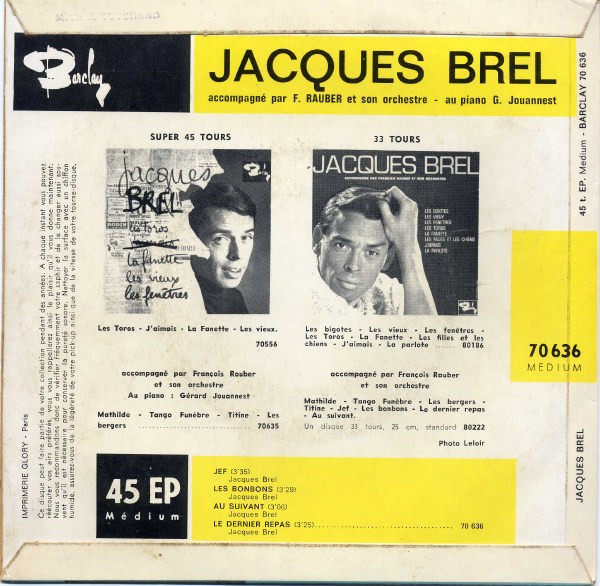
Overview
This EP was recorded over three days in January 1964 at Studios Barclay-Hoche Enregistrements in Paris, before being released the following March.
The songs —“Jef”, “Les Bonbons”, “Le Dernier Repas” and “Au Suivant”—showcase Brel’s trademark mix of humour, melancholy and biting social commentary. Each track tells a vivid story, capturing the listener’s imagination through Brel’s powerful lyrics and distinctive vocal delivery, and the fitting arrangements by long term collaborator Francois Rauber.
Analysis
“Jef” is one of Jacques Brel’s most poignant and emotionally charged songs, centering on the narrator’s attempt to console his friend Jef, who is devastated by heartbreak. The song paints a picture of tough love, as the narrator urges Jef to stop wallowing in despair and embrace life’s simple pleasures once again. References to drinking, singing, and dreaming of America offer nostalgic glimpses of happier times, as the narrator tries to rekindle their shared joys. The language is direct, almost brusque, as the friend knows that Jef needs a firm push to keep going, despite his pain.
Musically, the song features a swirling orchestration that mirrors the emotional turbulence of Jef’s despair. François Rauber’s arrangement enhances this sense of chaos, while the accordion in the refrain brings a brighter, more hopeful tone, as the friend offers bursts of camaraderie. Brel’s vocal delivery moves between tenderness and urgency, capturing both the frustration and deep affection of the narrator. The repetition of “Jef, you’re not alone” serves as both a plea and a lifeline, symbolising the profound bond of friendship in the face of loneliness and despair.
“Les Bonbons” (“The Candies”) is a clever and ironic song that showcases Brel’s humor and sharp social observation. The narrator attempts to woo a young woman by offering her sweets, reasoning that they are more practical than flowers, which are “perishable.” His approach to romance is awkward and naive, as he plans a simple date of watching trains and attending a public concert. As the story unfolds, it becomes clear that while the narrator believes he is charming her, the girl is using him as a cover to meet her real lover, Léon.
The twist comes at the end when, after realizing he’s been duped, the narrator quickly shifts his attention to Germaine—a woman he had insulted earlier in the song, calling her “ugly” and “cruel.” His fickleness mirrors the very behavior he condemned, showing how easily he, too, can switch affections. François Rauber’s light, upbeat orchestration complements the humour of the lyrics, while Brel’s expressive delivery brings out the comedic yet slightly bitter undertones of the song’s ending.
“Le Dernier Repas” (“The Last Meal”) is a darkly humorous and introspective meditation on death, where Brel’s narrator imagines a lavish, eccentric final gathering. He lists a bizarre assortment of people, animals, and even strangers to join him in this farewell feast. The inclusion of such an eclectic mix, from brothers and neighbors to pets and distant cousins, underscores the narrator’s view of life as an absurd blend of relationships and experiences.
The song presents an irreverent bravado, with the narrator mocking religious symbols and societal norms. He wishes to drink communion wine while “devouring cassocks” and insult the bourgeoisie “one last time.” Yet, beneath this facade of defiance, there is an undeniable vulnerability. In the closing lines, the narrator admits that despite his bluster, he will ultimately be afraid when death arrives. This admission strips away his rebellious exterior, revealing a deeply human fear of the unknown.
Though the song is filled with wit and irreverence, the music tempers this, emphasizing the deeper existential themes Brel is known for exploring. The song connects to Brel’s broader musings on mortality, such as in “Le Moribond” and “Le Tango Funèbre”, but stands out for its mix of humor and raw honesty, making it a memorable and thought-provoking reflection on life’s inevitable end.
“Au Suivant” (“Next”) is one of Jacques Brel’s most harrowing songs, exposing the dehumanization of military life through the narrator’s traumatic experience at a military brothel. Reduced to just another body in a line of 120 soldiers, the young man is stripped of dignity as he faces the mechanical chant of “Next!” Brel uses this to critique how military systems exploit and erase individuality, turning intimacy into a cold, transactional act.
The trauma scars the narrator, tainting every future intimate moment with echoes of the humiliation. Brel also references Waterloo and Arcole to convey the hollowness of the experience—not a victory or defeat, just an empty ritual.
Musically, François Rauber’s arrangement intensifies as the song progresses, mirroring the rising emotional tension. The relentless, driving rhythm reflects the inescapable trauma the narrator endures.
“Au Suivant” has been covered by artists like Scott Walker and Nick Cave, each capturing its powerful commentary on exploitation, power, and the scars left by institutional dehumanization. Through its rawness and biting social critique, the song remains one of Brel’s most impactful works.
Details
Side A:
- Jef
- Les Bonbons
Side B:
- Le Dernier Repas
- Au Suivant
 Collecting Brel
David,So gre
LikeLike